UX Researcher & CRO Specialist · UK / Remote
I was watching how people behaved in products, communities and games long before anyone paid me to. UX gave me the methods to investigate properly — but the habit came first, and it doesn't switch off at six o'clock.
Open questions I keep returning to
WHERE IT CLICKED
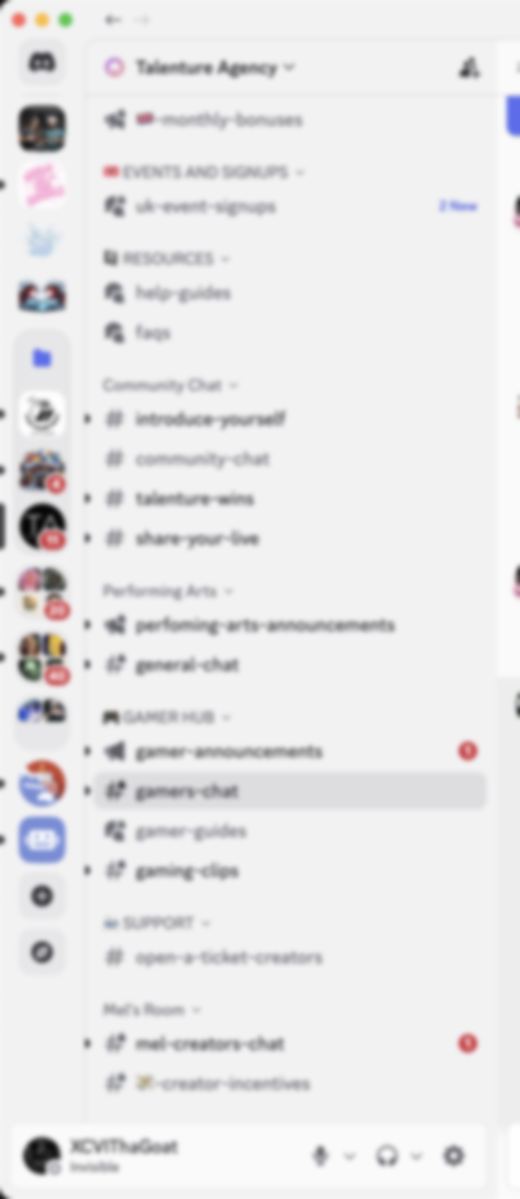
I met Discord the way most people in media do — as another workplace chat tool. Then my partner's gaming server pulled me into a completely different version of it.
People arrived wanting to network. Most stayed because they wanted connection. Those aren't the same thing, and the gap between them explained almost everything going wrong.
Members promoting constantly and building no relationships. Conversations turning transactional. Channels going quiet.
"How do we grow this?" — growing it would only have added more people to the same dynamic.
Why aren't people getting what they came here for? What behaviours create belonging? How do you let people with different intentions share one space?
Rebuilt the server around motivations rather than topics — room to promote, room to just play, room for creative work, room for support, room for the film nights that mattered more than any growth tactic.
What changed
People came back more often. Conversations loosened up. Promotion became a by-product of the community rather than its purpose — and members started describing it as somewhere they belonged.
Nothing about that is different from product work. Same questions, same evidence, no research budget.
Philosophy
I don't optimise interfaces. I study environments where people interact.
Products, communities, games, creative spaces. The questions barely change: how do people behave here, what motivates them, where does confidence disappear, what makes them stay, what makes them leave. The interface changes constantly. Human behaviour rarely does.
AN UNDERRATED RESEARCH ENVIRONMENT
Millions of players describing, in public and in detail, exactly what frustrates them, where they stopped playing, what felt unfair, what broke their trust and what they wish existed. No recruitment, no incentive, no observer effect.
What most people see
Complaints. Noise. Players who don't understand the constraints the team was working under.
What I see
Behavioural evidence at a scale no research budget could buy — with the drop-off point, the trigger and the emotional reasoning all volunteered unprompted.
I'd like to end up in those rooms eventually — not because I'd know better than the people making those calls, but because I want to understand how they get made.
STILL UNANSWERED
Not things I've solved. Things I notice repeatedly and haven't fully worked out.
Why do people keep using products they complain about constantly?
What turns a community transactional — and can it come back from it?
What actually makes someone feel like they belong somewhere?
What happens inside a product team in the weeks before a controversial decision ships?
TOOLS
EDUCATION
MSc Digital Design
Southampton Solent University
2019 – 2020
PostgraduateBSc Business Information Technology
Southampton Solent University
2014 – 2019
UndergraduateEXPERIENCE
2024–
2026
GoToHealthcare
CURRENTUX Consultant · Social Care · Embedded
Embedded research on a platform where a drop-off means someone didn't get help. Mixed-method: heuristic audit, behavioural analytics, two rounds of moderated testing.
2024–
2025
WiseLaundry
UX Analyst · E-Commerce
Conversion research on a high-consideration retail purchase — where the barrier is confidence, not price.
2022–
2024
Kinesso
UX Analyst · Media & Advertising
Research into how campaign and media teams interpret performance data, and where that interpretation goes wrong.
2018–
2022
Contract & Agency
musicMagpie · Volvero · Fareham IC
E-commerce, mobility and innovation support. Where I learned to run research without a research budget.
"The most interesting user behaviour doesn't happen in a usability lab. It happens when people think no one is watching — and I've spent years in those spaces."
— ON RESEARCH METHODOLOGY
HOW I THINK
I've spent time on both sides of the screen — studying how people behave, and building the spaces they behave in. Those two things teach you different lessons, and the second one is harder to fake.
I don't just ask what the data shows. I ask what it feels like to be the person generating it — the empathy isn't performed, it's earned.
Behaviour over self-report
People are honest about what they want and unreliable about what they'll actually do. The interesting bit is always the gap between the two.
Context is everything
The same person is patient in one place and impatient in another. I've stopped believing in personas that follow you between contexts.
Trust is the metric that matters
Product page or Discord server, people stay where they feel safe and leave quietly where they don't. Nobody files a ticket about it.
Evidence, not instinct
My instincts are usually a decent first guess and a bad final answer. That's roughly what research is for.
SKILLS & METHODShover to pause ·
EXPERIENCE
4+
Years in UX research & CRO
Embedded
In-house product teams & agency delivery
MSc
Digital Design · Southampton Solent
UK / Remote
GMT · available now
Previously in research, analytics and CRO roles across social care, e-commerce, media and marketplace products. Full background →
WORKING TOGETHER
I work best embedded rather than at arm's length — close enough to the product decisions that research arrives while there's still time to act on it.
A finding that arrives after the decision is made is just an opinion with a chart. I'd rather give a team something directional on Tuesday than something perfect a month late — and be clear about which one they're getting.
At GoToHealthcare the client wanted more homepage content; the audit said less. I argued it with the data, they changed their mind, and drop-off fell. If the decision goes the other way, I'll help make it work and we'll measure it anyway.
Eight participants can tell you a mechanism exists. They can't tell you what it's worth. Being explicit about that is what makes the confident claims believable.
Most briefs start as "something's wrong and we're not sure what." That's the interesting part. I'm comfortable spending the first week establishing what the actual question is before anyone commits to answering it.
OFF THE CLOCK
When I use a product, I've never been able to stop at "do I like this?" The question that actually interests me is what the team was trying to influence, what evidence they had, and what they had to give up to ship it.
WHAT IT COMES DOWN TO
People deserve to feel heard.
Every project I've worked on started from the same observation — somebody's needs weren't being represented well enough, usually because nobody had asked properly.
Research is how you find that out before the assumption becomes a product.
FORMAL WORK
Across my case studies I've applied mixed-method UX research and CRO thinking to high-stakes product decisions at scale — from second-hand e-commerce trust to premium device conversion journeys. The briefs are different. The human behaviour isn't.
CeX
Trust · Second-hand retail
GoToHealthcare
Social care · Drop-off reduction
Samsung
PDP optimisation · A/B experimentation
WiseLaundry
AI companion · In progress
SEE IT IN PRACTICE
Four studies — one commissioned, three run on my own initiative. Each one shows the reasoning, not just the outcome.