← Case studies 04 / 04The Laundry Companion · WiseLaundryProduct Design · Research
Research in progress · Product in development

Rethinking how we make everyday laundry decisions.

A research-led product exploration into how contextual guidance could reduce the cognitive effort behind laundry — without taking control away from the user.

Current state · 04 / 05
  1. Discover
  2. Principles
  3. Prototype
  4. Test · Round 1(current)
  5. Iterate
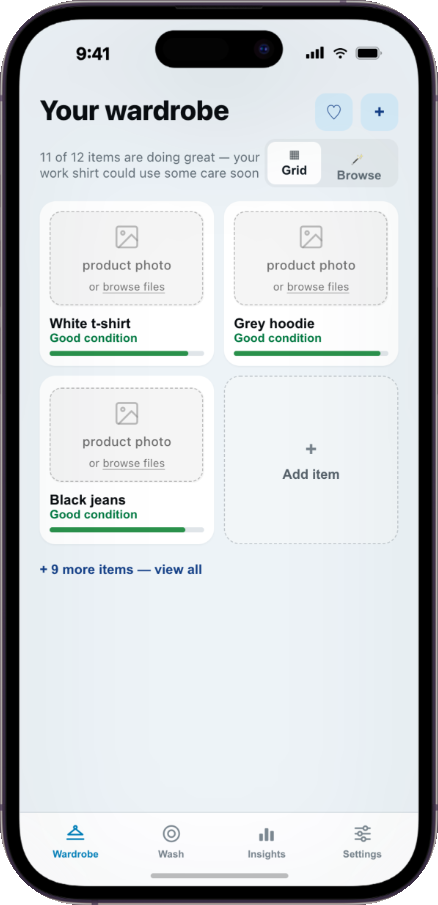
WiseLaundry wardrobe screen — eleven of twelve items doing great, the work shirt could use some care
Current directionDeliberately one screen, not the feature ecosystem.
ProjectWiseLaundry · own product, not client work
RoleUX Researcher & Product Designer
StatusRound 1 testing in progress · no findings yet
FocusResearch · Product strategy · UX design · Usability testing

Help users make better-informed laundry decisions with less cognitive effort — without asking them to surrender control.

Next · 02Why does this need to exist?
02The opportunity

Where does laundry become harder than it needs to be?

Behind a simple wash cycle sits a series of decisions. For some people they’re automatic. For others they create uncertainty.

  1. 01Before washingChoosing the right approach with confidence.
  2. 02When something goes wrongUnderstanding the problem and knowing what to do next.
  3. 03Before a consequenceIdentifying opportunities to prevent avoidable mistakes.
The design question

How might we reduce the cognitive effort of laundry decisions while preserving user understanding and control?

Next · 03What did we need to understand first?
03The research

The challenge wasn’t doing laundry. It was the thinking behind the decisions.

Exploratory interviewsBehavioural patternsOpportunity areasNot to prove WiseLaundry should exist — to find out whether there was a problem worth solving.
  1. Insight_01More settings don’t automatically create more confidence.Access to choice doesn’t mean confidence in making the right one.
  2. Insight_02Convenience is also about reducing cognitive effort.Hard-to-interpret information pushes people back to familiar defaults.
  3. Insight_03Automation preferences exist on a spectrum.Reducing effort shouldn’t remove the ability to decide.
  4. Insight_04Support often starts after the problem.Technical feedback only helps if it can become an action.
  5. Insight_05 · creates a tensionTiming matters.Guidance may be worth more before a mistake than after it.
04The principles

The research didn’t give me a feature list. It gave me a set of principles.

  1. Choice can create uncertaintyGuide, don’t overwhelm
  2. Recommendations need trustExplain, don’t just recommend
  3. Automation preferences varyAssist, don’t take over
  4. Problems create reactive behaviourSupport the moment of need
  5. Some mistakes may be preventablePrevent where possible
How the direction shifted
ExplorationA generic “smart laundry app”
Current directionFocused on moments where assistance helps users understand, decide and act.
One contextual-guidance system · four moments it supports
01“I need to choose”Find the best wash settings
02“Something went wrong”Machine diagnostics
03“I might make a mistake”Preventative guidance
04 · Exploratory“I want to understand longer-term care”Garment Health
Next · 05What does that look like?
05The product

Designed around moments of uncertainty.

Journey one · Find the best wash settings

From “what do I pick?” to a more informed decision.
Provide contextReceive recommendationUnderstand whyReview or adjustProceed
Because we sawMore settings didn’t create more confidence, and hard-to-read information pushed people back to defaults.
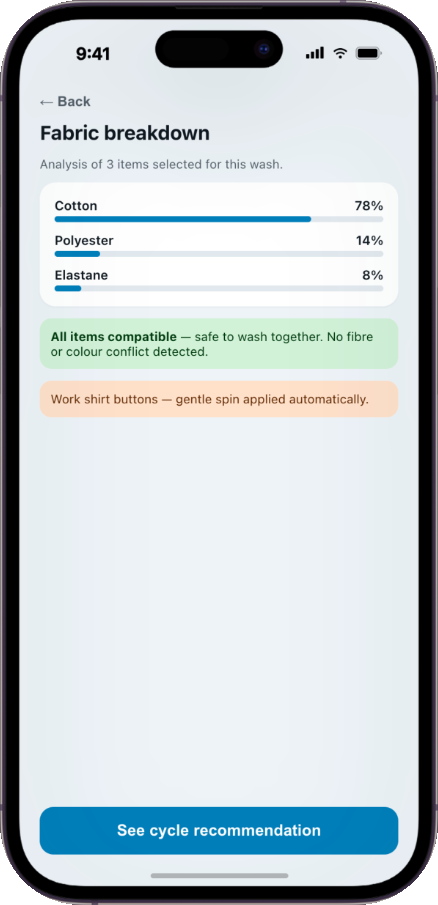
Fabric breakdown — 78% cotton, 14% polyester, 8% elastane, all items compatible
01 · Context first
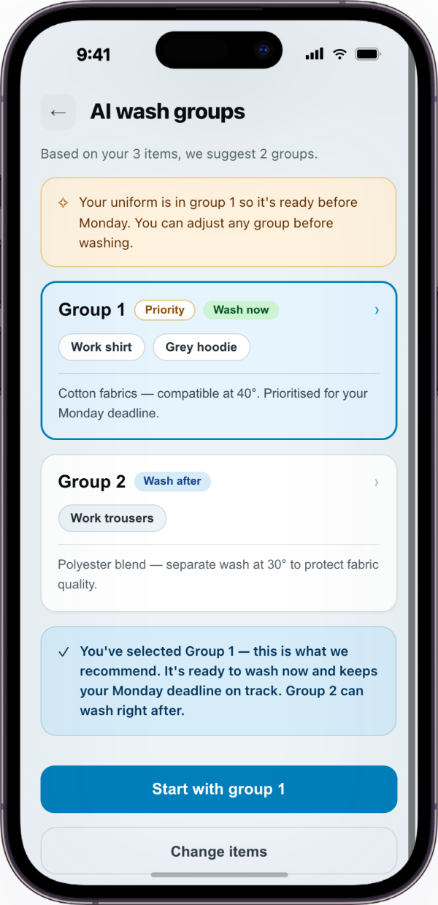
Wash groups — two suggested groups, each with its reasoning
02 · Recommendation, with its reasoning
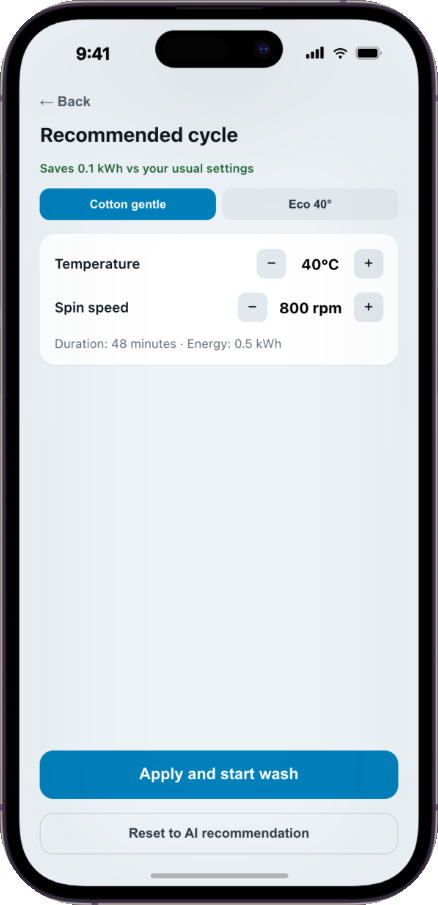
Recommended cycle — 40° and 800 rpm, with controls to adjust
03 · Review and adjust

Each screen states why before asking the user to accept anything — and the recommendation can be overridden without leaving the flow.

Journey two · Machine diagnostics

Turning technical problems into actionable next steps.

Identify issueUnderstand the problemFollow guided checksKnow what to do next
Because we sawSupport tended to start after the problem, and technical feedback only helped when it became an action.

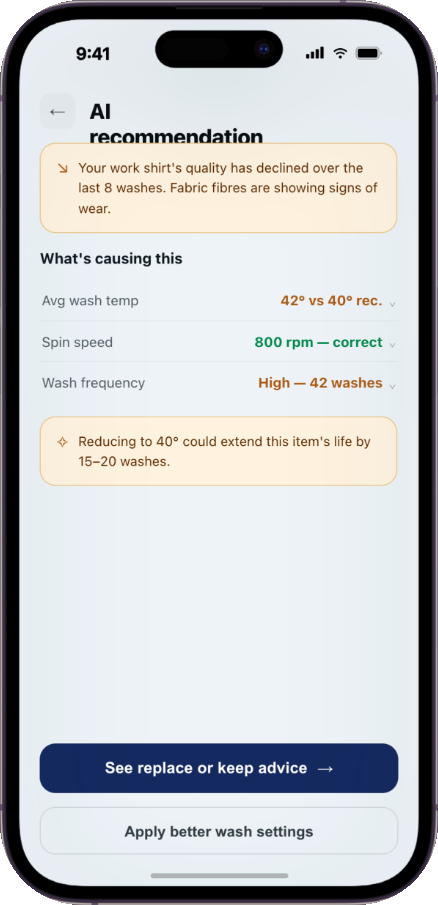
The explanation names what is already correct as well as what isn’t — so it reads as an assessment, not a list of faults.
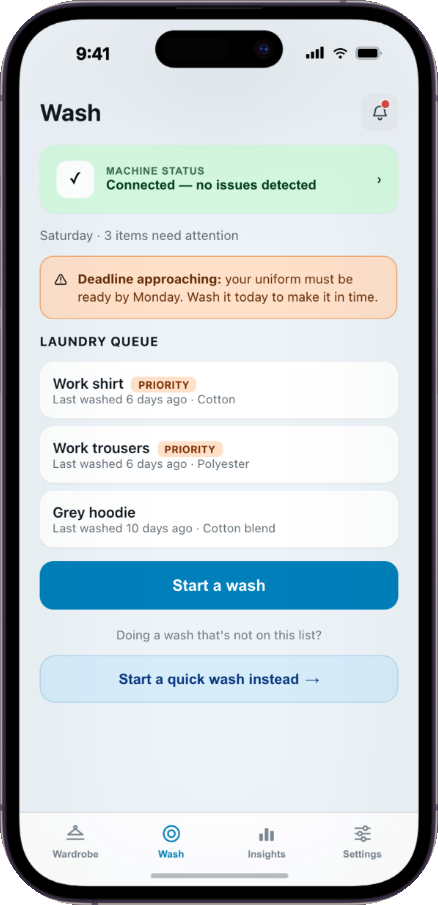
Wash screen — machine connected, a uniform needed by Monday, priority items in the queue
The issue, where the user already is
Recommendation — the work shirt’s quality has declined; plain-language causes and a next step
Plain language, then a next action
06Still exploring

The product isn’t finished because the thinking isn’t.

Preventative guidance · design question

When is a warning valuable enough to justify breaking the user’s flow?

An alert can be useful, or it can become another interruption.

Product hypothesis under evaluation

Garment Health — a longer-term view of clothing care.

Open question: is this a meaningful user need, and what would make the information credible enough to trust?
Shown as outcome. The underlying assessment model is commercially sensitive and isn’t published.
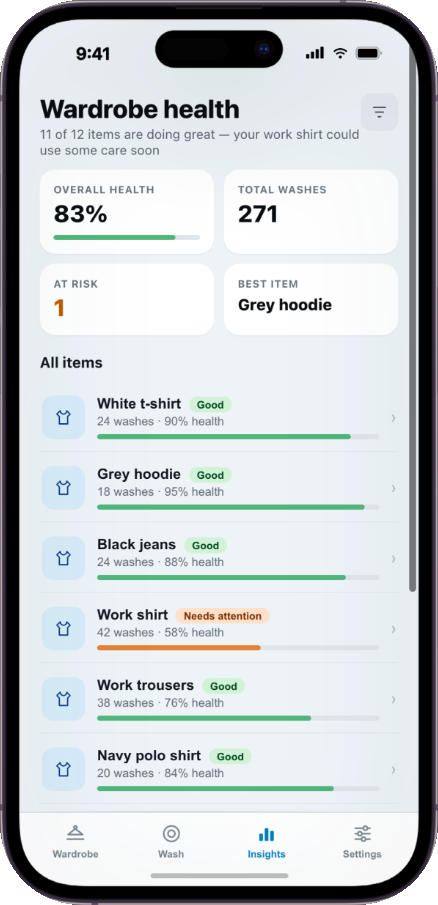
Wardrobe health — overall health, total washes, items at risk
The wardrobe as a whole
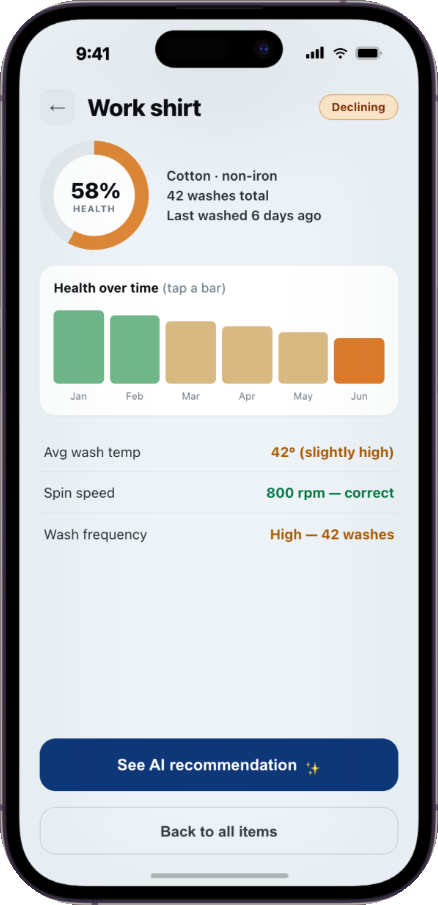
A single garment’s health over time
A single garment over time
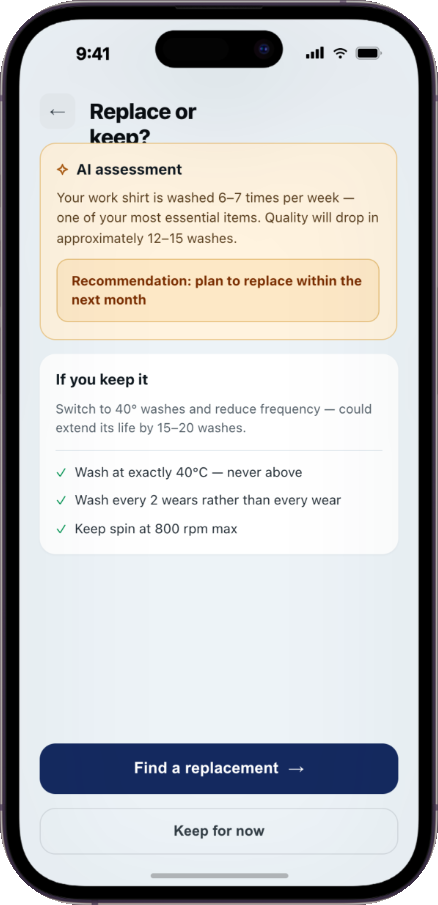
Replace or keep — an assessment and a recommendation
The decision it leads to
Next · 07How will we find out?
07Round 1

A polished prototype is not proof that the experience works.

Round 1 · in progress

Scenario-based usability testing around the core journeys — comprehension, trust, expectations and reactions to automation. No findings are reported until the patterns are synthesised.

Assumption_01○ TestingContextual guidanceDoes it genuinely reduce uncertainty?
Assumption_02○ TestingAI-assisted recommendationsWhat makes the output trustworthy?
Assumption_03○ TestingUser agencyWhere do people want assistance versus control?
Assumption_04○ TestingGuided diagnosticsCan users identify a meaningful next action?
Assumption_05○ TestingPreventative alertsHelpful intervention or unnecessary interruption?
Assumption_06○ TestingGarment HealthMeaningful proposition or interesting feature?
What happens next
  1. Complete Round 1 · now
  2. Synthesise patterns
  3. Review assumptions
  4. Prioritise
  5. Iterate
  6. Retest

The next iteration should respond to patterns in evidence — not isolated opinions, or a desire to defend the original concept.

08Still moving

Not a story about arriving at the perfect solution. A story about taking an idea seriously enough to let evidence change it.

Most valuable so far

Not a finished interface — enough evidence to challenge an idea I initially believed in.

Lessons so far

Research should shape direction, not decorate it. Explainability is part of the experience. Uncertainty can be a legitimate outcome.

My role

Sole designer and researcher — concept, prototype and study design.

FigmaMazeDovetailClaude
04 / 04The Laundry Companion · in developmentThe investigation continues.
More case studies
Observation
Users had intent, but lacked confidence.
Finding
The problem was structural.
Evidence
↓11% drop-off
View case study ↗
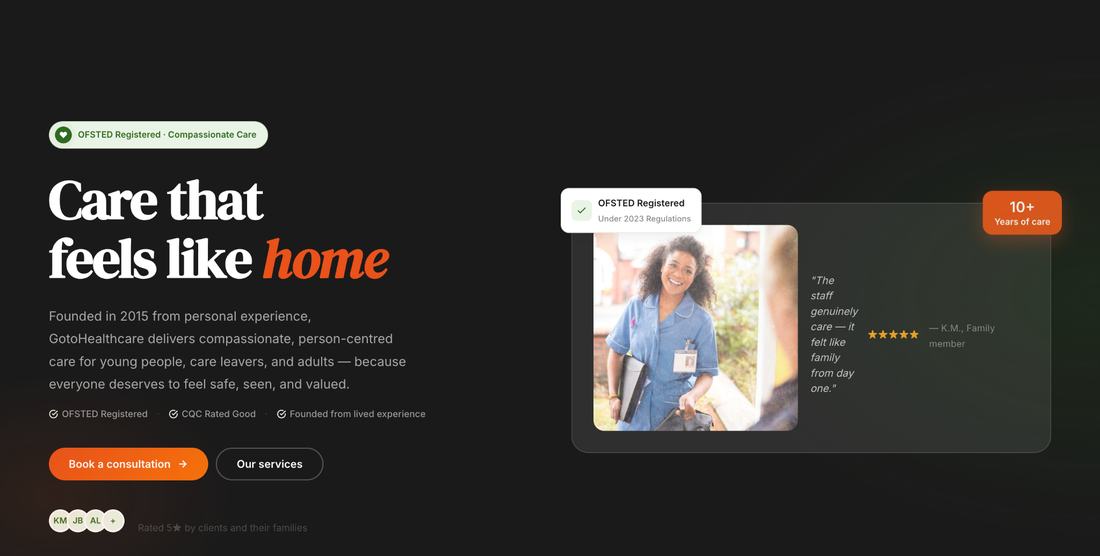
01The Confidence GapGoToHealthcare · UX Research · CRO
Observation
Important product content sat below the fold.
Finding
The page looked complete. The journey wasn’t.
Scope
4 isolated experiments designed
View case study ↗
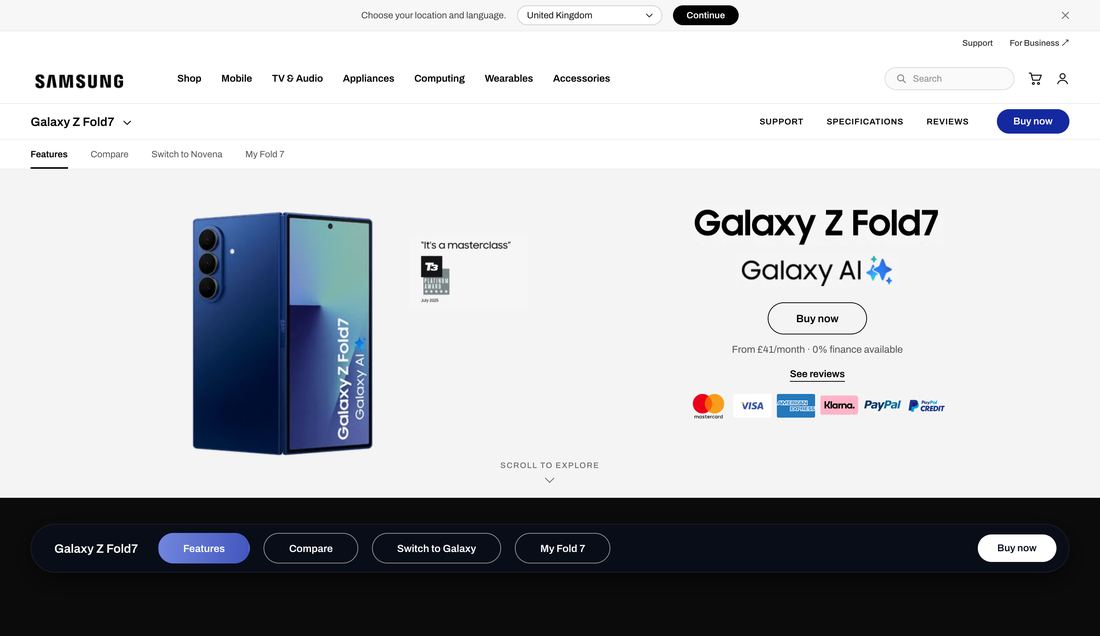
02The False BottomSamsung · CRO · Experimentation
Observation
The information was there. The confidence wasn’t.
Finding
Reassurance sat nowhere near the hesitation.
Scope
8 participants · 2 cohorts
View case study ↗
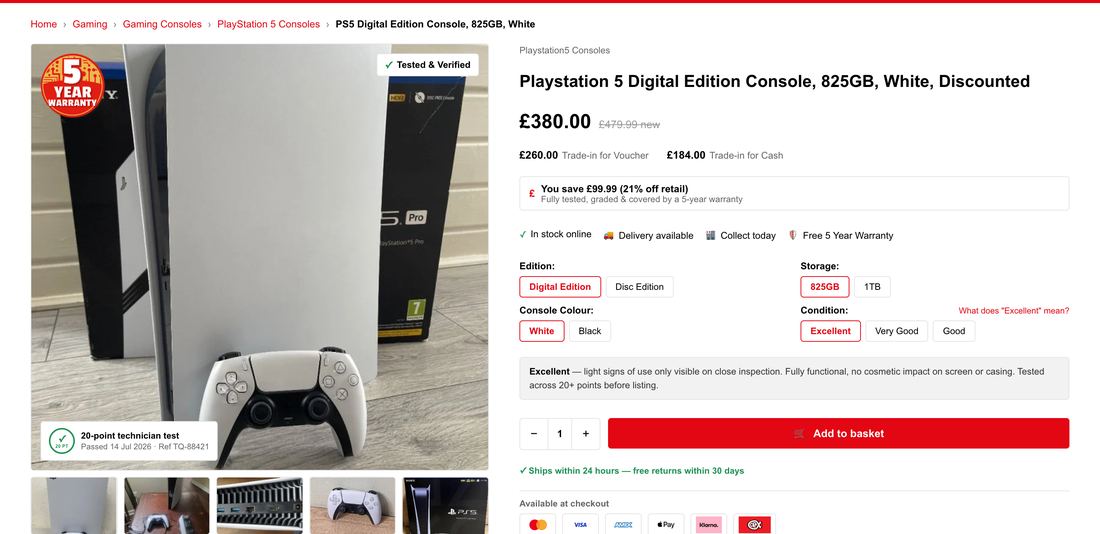
03The Trust GapCeX · UX Research · Usability
In development Current
04The Laundry CompanionWiseLaundry · Product Design · Research